A threat actor can abandon a username, delete a social media profile, and tighten their operational security. That does not erase the accounts they created years earlier—or the information other people and organizations collected about them.
For investigators, those older traces can provide a starting point. The challenge is connecting them without mistaking a plausible association for a proven identity.
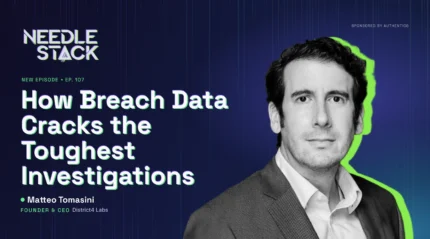
In episode 107 of NeedleStack, District4 Labs founder and CEO Matteo Tomasini joins AJ Nash and Kacper Piwowar to explain how breach data supports hard target investigations. Their conversation covers digital footprinting, threat actor attribution, AI-assisted analysis, and the validation that makes findings useful.
The central lesson: every identifier is a lead that needs context.
What is breach data’s role in OSINT investigations?
Breach data can help investigators connect identifiers—such as email addresses, usernames, and phone numbers—across otherwise separate sources. Used alongside public records and social media, it can reveal historical associations and generate leads for identity resolution. Those connections require validation before they support attribution.
Tomasini describes breach data as a way to connect fragmented information. An email address found in public records might appear alongside a different username in an exposed dataset. That username could lead to an older account and another source of corroboration.
Its value comes from how it fits into the wider investigation. A record’s presence in a dataset does not establish that the dataset is authentic, that its label is accurate, or that the person named controlled the account at the relevant time.
Start with identifiers you can validate
Hard target investigations often begin with ordinary sources. Tomasini describes starting with public records and investigative databases to identify possible names, phone numbers, email addresses, and physical addresses.
“Possible” matters. An address may belong to a relative. A phone number may be a work number or have changed hands. A common name may combine records belonging to different people.
Before expanding the investigation, analysts need to examine those initial associations. Useful questions include:
- Where did this identifier originate, and how old is the record?
- What other sources connect it to the subject?
- Do those sources provide independent confirmation or repeat the same underlying data?
- What contradictory information needs to be resolved?
Validation continues throughout the investigation. Each new identifier creates another opportunity to follow the wrong person if the association goes unchecked.
Why historical data matters for hard targets
A subject’s current operational security may be stronger than their past habits.
Tomasini recounts investigations in which older gaming accounts helped connect threat actors to identifying information. Someone who carefully separates accounts today may have used a more revealing username years earlier, before they had a reason to conceal their identity.
That creates opportunities to pivot: use a validated identifier from one source to search for relevant information in another.
An older account might introduce a distinctive alias. A historical record might connect that alias to an email address. A separate source might help establish whether that email belongs to the subject.
The timeline is part of the analysis. A historical association can help explain an identity, but it does not automatically establish present ownership, location, or activity.
How investigators pivot across data sources
Strong investigations move between sources as the evidence develops. Public records, breach data, social media, and internet infrastructure can each contribute different pieces of context.
Tomasini illustrates this with an investigation that began with a common Discord username. According to his account, a message introduced a Steam identifier. Reviewing historical Steam aliases revealed a more distinctive username, which opened another investigative path and ultimately helped identify the subject.
The lesson is broader than any particular tool: analysts need to know what information may exist and how one source can connect to another.
A practical workflow drawn from the discussion is:
- Establish the starting point. Record the initial identifier, its source, and what remains uncertain.
- Develop candidate associations. Look for relevant connections across available sources.
- Validate each pivot. Check ownership, dates, source quality, and alternative explanations.
- Preserve the supporting material. Capture the context needed to explain the connection later.
- Reassess the hypothesis. Resolve contradictions before building further conclusions on top of it.
This process is iterative. Sometimes the most useful result is discovering that a promising lead does not belong to the subject.
Treat fabricated breach data as an investigative risk
Real information can appear inside a misleading dataset.
In the episode, Tomasini describes reviewing a purported cryptocurrency customer dataset. Some personal information appeared accurate, but repetitive company names, unusual address patterns, and suspicious financial values led him to question its authenticity. His assessment was that legitimate contact information had been combined with fabricated details.
That distinction matters. An accurate email address does not validate every other field beside it. Nor does a dataset’s advertised name prove that the named organization suffered the claimed breach.
Analysts should examine the source’s history, the structure of the records, and whether the claimed origin fits the content. Otherwise, a genuine identifier can become the foundation for a false conclusion about someone’s accounts or activity.
Where AI helps—and why analysts still need to verify results
Tomasini sees value in using AI to triage large volumes of posts, surface potentially relevant material, and summarize information for review. His concern is accepting the resulting associations without understanding how they were produced.
A polished report can conceal an unsupported connection. If an early pivot is wrong, later findings may describe an entirely different person while appearing internally consistent.
For AI-assisted OSINT, the analyst still needs to establish:
- Which source supports each association.
- Whether the underlying material actually supports the stated conclusion.
- What uncertainty or conflicting information the summary leaves out.
- Whether another analyst could reconstruct the investigative path.
Automation can help prioritize work. The investigator remains responsible for deciding what the results mean and whether they justify the next step.
Preserve provenance and explain your confidence
Online material can disappear. Tomasini describes preserving pages during investigations so that a finding remains explainable after the original content changes or goes offline.
A useful investigative record connects the observation to its source, collection time, surrounding context, and analytical significance. It should distinguish what the investigator observed from what they inferred.
The same discipline applies to attribution. A record associated with a device does not necessarily identify the person using it. Shared devices and accounts create alternative explanations that require investigation.
As Tomasini puts it, “You really have to show your work.”
A report should explain why an identity assessment is supported, what weakens it, and what remains unresolved. Confidence language helps communicate uncertainty when it is backed by that reasoning.
Protect the investigator’s digital footprint, too
The discussion of threat actors’ operational security has a parallel for investigators: account habits and identity mistakes can also expose the person conducting the research.
During the episode, Nash describes using Authentic8 Silo to help manage aspects of his investigative environment. Authentic8’s Silo Managed Attribution Network supports Silo Workspace access to surface, deep, and dark web content through globally distributed endpoints.
The human decisions still matter. Signing into a personal account or reusing an identifying alias can connect activity that an investigator intended to keep separate. A managed environment works alongside disciplined account use and investigative tradecraft.
Strong attribution depends on the connections you can explain
Breach data can open investigative paths that public profiles alone do not reveal. Historical accounts and exposed identifiers may help connect a hard target’s fragmented footprint—but only when analysts verify the sources and test each association.
Tomasini’s advice is to understand what data and tools make possible, then spend the time needed to interpret the results. Better attribution comes from connecting information in ways another investigator can examine and challenge.
Watch the full NeedleStack episode with Matteo Tomasini for more on breach data, hard target investigations, and the tradecraft behind defensible findings.