As AI-generated content becomes increasingly difficult to distinguish from human-created material, watermarking promises greater transparency. But can it deliver the certainty that intelligence professionals need?
Artificial intelligence has fundamentally changed how information is created, distributed, and consumed. From AI-generated research reports to realistic deepfake videos, synthetic content is becoming increasingly sophisticated and harder to distinguish from authentic material.
For intelligence analysts, cybersecurity professionals, and OSINT investigators, this creates a critical challenge: How can you determine whether information is authentic, reliable, and suitable for intelligence analysis?
AI watermarking has emerged as one potential answer.
Designed to identify AI-generated content through embedded markers or detectable patterns, AI watermarking aims to introduce greater transparency into an increasingly synthetic information environment.
But the technology raises important questions about accuracy, accountability, and the consequences of incorrectly identifying content as AI-generated.
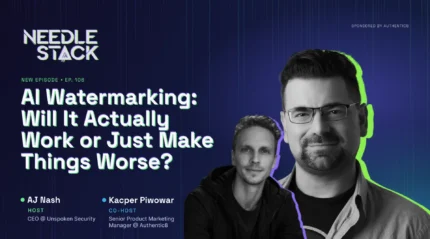
In episode 106 of Authentic8’s NeedleStack podcast, hosts AJ Nash and Kacper Piwowar explore the technical limitations of AI watermarking, the challenges of emerging regulations, and why traditional intelligence tradecraft may be more important than ever.
Their central takeaway: AI watermarking may help identify synthetic content, but it cannot replace rigorous source verification, traceability, and human judgment.
What is AI watermarking?
AI watermarking is a technique used to embed identifiable signals or patterns into AI-generated text, images, audio, or video. These signals can help specialized detection systems identify content produced by artificial intelligence.
Unlike traditional watermarks, which are often visible logos or text overlays, AI watermarks may be invisible to human observers.
They can exist within file metadata, image pixels, or statistical patterns in generated text.
The objective is to make AI-generated content detectable without significantly affecting the quality or usability of the original material.
However, an important distinction exists between detecting an embedded watermark and determining whether content was created by AI.
A watermark can provide evidence of a particular generation process, but its presence or absence does not independently establish whether the underlying information is accurate or trustworthy.
For intelligence professionals, this distinction is essential.
An AI-generated report may contain accurate, well-supported findings. Conversely, a human-created document may contain fabricated claims, misleading evidence, or intentionally manipulated information.
Content authenticity requires more than identifying the technology used to produce it.
How does AI watermarking work?
AI watermarking technologies generally fall into three categories, each with different strengths and limitations.
| Method | How it works | Key limitation |
|---|---|---|
| Metadata and provenance markers | Attach information about a file’s origin or history | Metadata may be removed or lost |
| Invisible watermarks | Embed detectable patterns within generated content | Editing or transformations may weaken detection |
| Model-level watermarking | Introduce detectable statistical patterns during generation | Detection depends on the method, available keys, and subsequent modifications |
1. Metadata and content provenance
Metadata-based approaches attach information to digital content that can help establish its origin and history.
One prominent initiative is the Coalition for Content Provenance and Authenticity (C2PA), which develops technical standards for documenting the provenance of digital media.
C2PA-based Content Credentials can help identify information about how content was created or modified, when supported by the relevant tools and systems.
However, provenance metadata and AI watermarking are not interchangeable.
Provenance records help establish a chain of information about a digital asset, while watermarking introduces a detectable signal into the content itself.
Both can contribute to transparency, but neither guarantees that the claims within a document or image are truthful.
2. Invisible watermarks
Invisible watermarking embeds signals directly into generated media, such as subtle pixel-level patterns in images.
These markers are designed to remain imperceptible to viewers while being recognizable to specialized detection systems.
Unlike simple metadata, some invisible watermarks can survive certain file modifications.
However, their durability varies depending on the implementation and the transformations applied to the content.
Cropping, compression, editing, or other processing can affect detection reliability.
3. Model-level watermarking and fingerprints
Model-level watermarking uses patterns introduced during AI generation to help distinguish watermarked output from other content.
For text, some approaches influence token selection in ways that produce a statistically detectable signature.
In the NeedleStack discussion, Piwowar describes an analogy involving a game of Monopoly.
Instead of determining each move through ordinary dice rolls, imagine using a predetermined sequence of numbers.
To players who do not know the sequence, the moves might appear random. But someone with access to the underlying pattern could potentially recognize how those moves were generated.
A similar principle can apply to certain text watermarking systems.
These techniques differ from passive AI detection, which attempts to infer AI authorship from content characteristics without necessarily identifying an embedded watermark.
That distinction matters because detecting a known watermark and estimating whether text resembles AI output are different technical problems.
Why is AI watermarking becoming important?
The rapid adoption of generative AI has created new challenges for digital trust.
AI-generated content can now imitate human writing, produce convincing images, and generate realistic audio and video.
These capabilities offer significant productivity benefits, but they can also support misinformation, impersonation, fraud, and influence operations.
For security and intelligence teams, the implications extend beyond determining whether a document was written by a person or an AI model.
Synthetic media can complicate investigations by introducing fabricated evidence, misleading narratives, or manipulated identities into the information environment.
AI watermarking is one attempt to address these challenges.
Regulatory initiatives, including transparency requirements under the European Union’s AI Act, have also increased attention on mechanisms for identifying AI-generated content.
However, the regulatory requirements, technical implementations, and practical effectiveness of different watermarking systems should not be treated as equivalent.
As Nash and Piwowar emphasize, the intention behind greater transparency may be valuable even when the technology cannot deliver certainty.
Can AI watermarking reliably detect AI-generated content?
AI watermarking can provide useful evidence that content was generated by a particular AI system, but detection is not infallible. Reliability depends on the watermarking method, content type, detector, and whether the material has been modified.
This creates two significant risks.
False positives: Authentic work incorrectly identified as AI-generated
A false positive occurs when a detection system incorrectly classifies human-created content as AI-generated.
For professional researchers, analysts, writers, and investigators, the consequences can be significant.
An intelligence assessment incorrectly labeled as AI-generated could face additional scrutiny, even if its underlying findings are accurate and thoroughly documented.
Nash describes his experience submitting older, human-written material to commercial AI detection systems and receiving high AI-generated probability scores.
His example highlights a broader concern: writing characteristics associated with AI may also appear in legitimate human-authored work.
Structured language, formal tone, and consistent formatting are not proof of AI authorship.
For intelligence professionals, whose reports often follow established analytical conventions, reliance on stylistic detection alone can be especially problematic.
False negatives: AI-generated content goes undetected
The opposite problem occurs when AI-generated material is not identified by a detector.
A missing watermark does not prove that content was created by a human.
Watermarks may not be present in every AI output, and subsequent transformations can interfere with detection.
This creates a risk of false confidence.
An analyst who interprets a negative detection result as proof of authenticity may overlook fabricated claims or manipulated evidence.
The critical lesson is that AI detection results should be treated as one investigative signal, not a final determination of authenticity.
The risks of relying too heavily on AI detection tools
The most significant concern raised during the NeedleStack discussion is not simply whether watermarking works.
It is how organizations will interpret and act on detection results.
An AI detection score can appear objective, particularly when generated by a sophisticated technical platform.
But a numerical result may not communicate the system’s limitations, uncertainty, or potential for error.
This becomes particularly consequential when the results influence decisions involving employment, academic integrity, procurement, legal proceedings, or intelligence reporting.
Nash warns that organizations may overlook caveats about detection accuracy and treat the output as definitive evidence.
For intelligence and security teams, that approach introduces unnecessary analytical risk.
A detector’s output should be evaluated alongside other evidence, including the source’s credibility, the content’s provenance, corroborating information, and the methods used to develop the assessment.
The goal should not be to eliminate technology from the verification process.
It should be to ensure that technology supports, rather than replaces, sound investigative judgment.
Why content provenance matters more than an AI detection score
One of the strongest themes throughout the episode is the importance of traceability.
Intelligence professionals have long relied on established methods for evaluating sources, documenting evidence, and distinguishing verified findings from unsupported assertions.
Those practices remain essential in an AI-driven information environment.
As Nash explains:
“Sources and methods still matter.”
An intelligence assessment should be defensible because its findings can be traced to credible evidence, not because a detection tool assigns it a favorable score.
This means investigators need to understand where information originated, how it was collected, whether it has been altered, and what evidence supports the conclusions drawn from it.
For OSINT and CTI analysts, this creates several practical requirements.
- Preserve original sources. Maintain access to the material supporting investigative findings whenever lawful and appropriate.
- Document collection methods. Record how information was discovered, captured, and analyzed.
- Corroborate important claims. Validate findings against independent and credible sources.
- Distinguish evidence from assessment. Make clear which conclusions are directly supported and which involve analytical judgment.
- Maintain an audit trail. Preserve the information needed to reconstruct and defend investigative decisions.
These practices strengthen the integrity of intelligence reporting regardless of whether AI was involved in producing the final assessment.
How AI watermarking affects OSINT and threat intelligence investigations
For OSINT and threat intelligence professionals, AI watermarking introduces another factor to consider during the intelligence lifecycle.
Investigators routinely encounter unverified information across websites, forums, social platforms, and other external sources.
Increasingly, that information may include AI-generated material.
Watermarking and detection tools can help inform investigative decisions, but they do not eliminate the need to validate the underlying evidence.
A defensible approach requires maintaining investigative integrity from initial collection through final reporting.
Applying verification throughout the intelligence lifecycle
- AccessEnter external threat environments through controlled, isolated workflows that protect investigative infrastructure and reduce unnecessary exposure.
- CapturePreserve relevant digital evidence and associated source context so analysts can revisit the material supporting their findings.
- AnalyzeEvaluate source credibility, corroborate information, and consider AI detection signals alongside other evidence rather than treating them as conclusive.
- ReportProduce assessments supported by traceable sources, documented methods, and clearly communicated confidence levels.
This is where secure investigative workflows become especially important.
Authentic8’s Silo provides a unified workspace designed to protect, mask, and accelerate digital investigations.
By enabling investigators to access and engage with external threat environments through an isolated workspace, Silo helps teams reduce exposure while supporting controlled investigative workflows.
Its approach aligns with four essential operational priorities:
Protect: Isolate investigative activity from external threats.
Mask: Conceal investigative identity and geolocation to reduce attribution risk.
Accelerate: Harmonize workflows to help analysts move from information collection to actionable intelligence faster.
Manage: Control access, define policies, and support compliance requirements.
While Silo is not an AI watermark detector, secure access, disciplined collection, and defensible investigative processes remain important foundations for evaluating potentially manipulated information.
Should intelligence teams stop using AI?
No. The emergence of AI watermarking does not mean intelligence professionals should abandon generative AI tools.
Instead, it reinforces the importance of using those tools responsibly.
AI can assist with research organization, summarization, editing, and other analytical support tasks.
However, analysts remain responsible for validating information, understanding the limitations of AI-generated output, and defending their conclusions.
A useful distinction is between using AI to support an investigation and allowing AI to determine the outcome without sufficient oversight.
As Nash argues in the episode, the priority should be whether the information is accurate, properly sourced, and defensible.
That principle applies regardless of the tools used during the process.
For organizations integrating AI into intelligence workflows, clear usage policies and documentation standards can help maintain accountability without unnecessarily restricting productivity.
The future of AI watermarking and digital trust
AI watermarking will likely remain part of the broader discussion around synthetic content, provenance, and digital authenticity.
But watermarking alone cannot resolve the underlying trust challenges created by generative AI.
Piwowar argues for a broader approach that combines technical detection with media literacy, platform moderation, accountability, and verification.
For intelligence professionals, this reinforces a familiar principle: reliable assessments require multiple sources of evidence and disciplined analysis.
As AI-generated content becomes more common, the ability to establish where information originated and why it should be trusted may become more valuable than simply determining whether AI participated in its creation.
The future of digital trust will depend not only on increasingly sophisticated detection technologies but also on the ability of individuals and organizations to verify information and defend their findings.
Key takeaway: Verify the evidence, not just the watermark
AI watermarking represents an important effort to introduce transparency into an increasingly complex digital information environment.
However, it is not a substitute for evidence-based investigation.
For OSINT analysts, CTI teams, and security professionals, the most effective response is to strengthen established intelligence tradecraft.
Preserve sources. Document methods. Corroborate findings. Maintain traceability.
Above all, avoid treating a detection score as proof of authenticity.
In an environment where synthetic content is becoming increasingly sophisticated, the ability to produce defensible intelligence will remain a critical differentiator.
AI may change how information is created, but it does not change the need to verify what is true.
Frequently asked questions about AI watermarking
What is AI watermarking, and how does it work?
AI watermarking embeds detectable signals into AI-generated text, images, audio, or video. These signals may take the form of metadata, invisible patterns, or statistical signatures introduced during generation. Specialized detection tools can identify some of these markers, helping establish whether content originated from a particular AI system, although results are not always conclusive.
Can AI watermarks be removed from generated content?
Some AI watermarks can be weakened, removed, or rendered undetectable through content modifications, depending on the technique used. Metadata may be lost during file processing, while invisible and statistical watermarks have varying levels of resilience. Consequently, the absence of a detectable watermark does not establish that content was created by a human.
Are AI content detection tools accurate?
AI content detection accuracy varies significantly across tools, content types, and detection methods. Some systems identify known embedded watermarks, while others estimate AI authorship based on statistical characteristics. Both approaches have limitations. Organizations should avoid treating detection scores as definitive proof and instead corroborate results with provenance information, source verification, and human review.
Why is AI watermarking important for OSINT investigations?
AI watermarking can provide OSINT investigators with additional context when assessing potentially synthetic information. However, a watermark does not establish whether a claim is truthful or an image accurately represents an event. Investigators should combine detection results with source validation, evidence preservation, corroboration, and documented analytical methods to produce defensible intelligence assessments.
How can intelligence teams verify AI-generated content?
Intelligence teams can verify potentially AI-generated content by examining its origin, preserving source material, checking provenance information, and corroborating claims against independent evidence. AI detection tools may provide supporting signals, but should not determine conclusions independently. Secure investigative workflows and documented collection methods help analysts maintain traceability and defend their findings.
FAQ search volume: Not verified for these exact questions. These are recommended based on relevance and search intent, not measured keyword demand.
Watch the NeedleStack episode
For a deeper discussion of AI watermarking, its limitations, and the implications for intelligence professionals, explore episode 106 of NeedleStack featuring AJ Nash and Kacper Piwowar.
Explore more episodes at Authentic8 NeedleStack.
Ready to strengthen your investigative workflows? Explore how Authentic8’s Silo platform helps teams securely access external threat environments, protect investigative identities, and accelerate intelligence operations. Try it today.